Retirement nearing? Do these 5 things first.
What’s your ideal retirement?
Traveling? Practicing your favorite hobbies? Caring for loved ones?
Whatever you envision, creating a plan of action can feel exhausting.
There are, however, a few simple, yet commonly overlooked steps you can take today to help you feel more comfortable throughout your planning process.
5 Tasks that Could Help You Find Retirement Bliss
Romantic ideas of retirement don’t become a reality all by themselves. They’re also not usually sustainable without a solid foundation and a well-thought-out plan. Part of that requires the tasks below, which can easily fall to the wayside, especially if you aren’t sure how to tackle them.
1. Budgeting & Number Crunching
How much will it cost to live every year you’re retired? What does your monthly budget in retirement look like?
Many of us know how much we need to save, so we can retire. Fewer of us have done the math to work out how much money we really need every month or year when we’re retired.
Pro tip: Consider taxes and all income streams you’ll have in retirement. Taxes alone could be a reason to rethink part of your retirement plans, like where you want to live as a retiree.
2. Factoring Inflation into Your Plans
How much will your retirement budget—and your purchasing power—change in 5 to 10 years?
Inflation can be the elephant in the room of retirement talks, and ignoring it can be a disaster for your future budget.
Pro tip: Estimate conservatively and reference the latest inflation rates. Also, don’t look at the numbers as absolutes. View them as “working” references that you may need to revisit in the future as inflation rates change.1
3. Planning for Longevity, Health Care & Long-Term Care
Ideal retirement plans now may not work for you in the future. It’s important to consider that your post-work life could last at least three decades.2
That means planning not just for your jet-setting retirement years but also for your later-in-life needs too.2
Pro tip: You aren’t locked into your retirement plan. If it’s not working or your needs evolve, your plan and the financial strategies that back it up can shift too.
4. Addressing Potential Boredom
Retiring can open up more time than you may be ready for, especially if your loved ones are busy with work or school. Boredom can become a real problem for retirees, as a lack of mental and emotional stimulation can negatively affect our health and quality of life.3
Pro tip: Think about creating new retirement habits and routines that are based on your passions and values. It can take time to construct a productive schedule, but once done, can provide consistent structure, comfort, purpose, and satisfaction.3,4
5. Considering the Possible Alternatives
Retirement doesn’t have to mean you never work again. These days, more people are carving out their own transitions into retired life. Entrepreneurship or scaled-down, part-time work schedules are popular options.
Pro tip: You don’t have to have to work in the industry you want to retire from, and you don’t need a high-powered job to make your professional life meaningful. Some may even choose to go back to school and be “professional students,” earning additional degrees instead of a part-time income.
Retirement Planning: What’s next?
You never have to plan for retirement alone—a fresh perspective, with some professional guidance, could give you a better way to live your life––your way.
Sources:
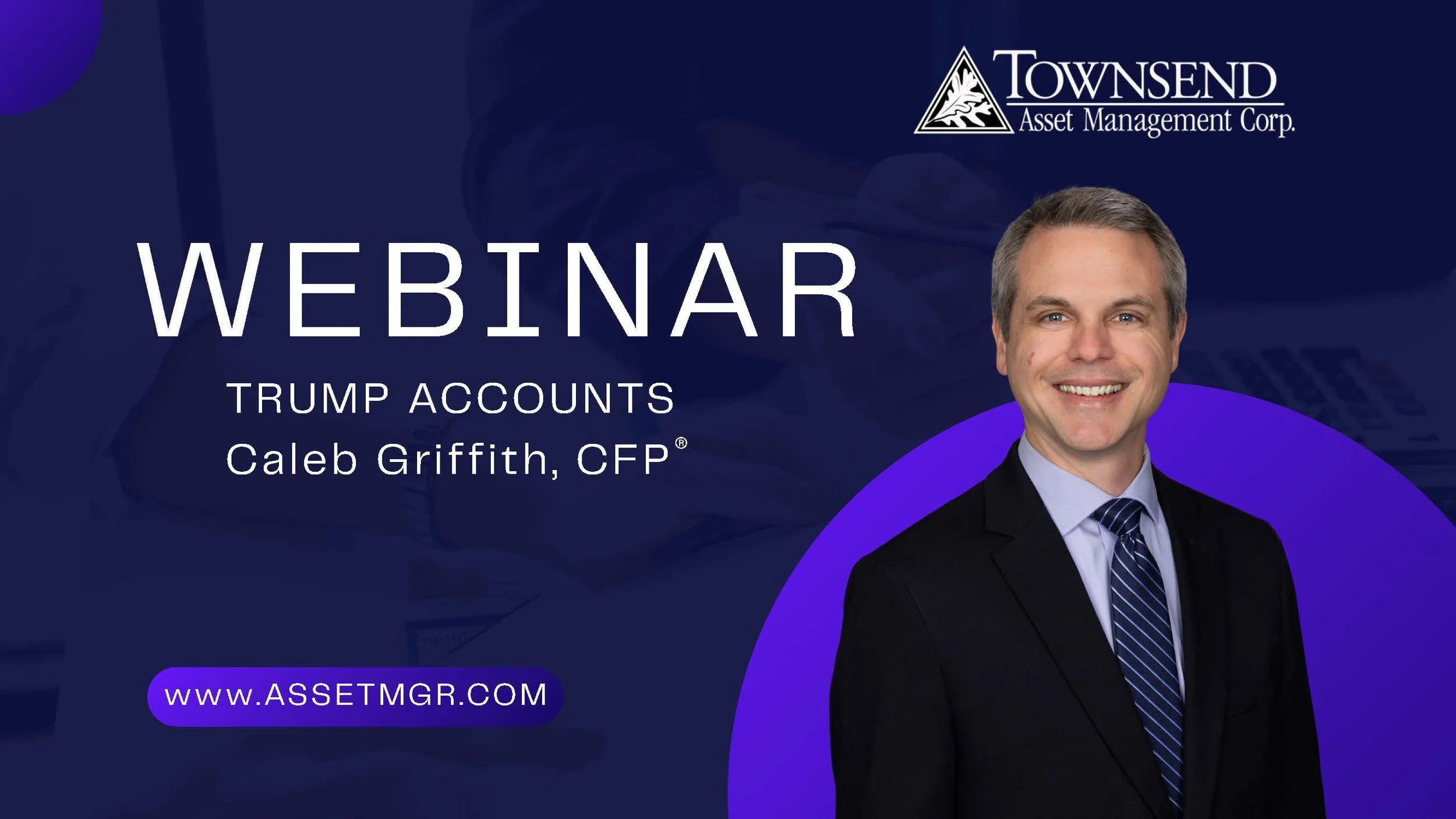
Gerald Townsend, founder of Townsend Asset Management, shares insights on navigating today’s financial environment and why thoughtful planning matters. In this CBS17 feature, he highlights the importance of clarity, confidence, and long-term vision in building financial security.
When the Dow soars or sinks, your brain sounds the alarm—“This must be the top!” or “Get out now!”
But investing isn’t about instincts; it’s about discipline.
Your emotional brain fears loss, while your rational plan builds wealth.
Success comes from staying steady when fear gets loud—and trusting the long game over short-term noise.
When markets hit record highs, many wait for a “better” entry—but history shows that waiting usually costs more. New highs are normal, not warnings. The real mistake isn’t buying at the top—it’s staying out and missing long-term growth.
Technology has changed nearly everything about the way we live, work, and connect including how scammers operate.
As spring arrives and the weather warms up, many people turn their attention to cleaning out closets and organizing their homes.
What makes one investor stick with their strategy through market swings while another panics and pulls out? Often, it comes down to mindset.
Tax season might not spark joy, but a refund sure can. In 2025, the IRS estimates the average federal income tax refund will top $3,170.1
What financial habits have helped you most in life or held you back? No matter how you answer, your money habits have a lot to do with how you grew up.
What will happen to your business when it’s time for you to take a step back? That can be a tough question that many business owners eventually have to face.
Tax season doesn’t have to feel like an uphill battle. With the right strategies, you can minimize your tax bill and keep more of your hard-earned money where it belongs, in your pocket.
Market volatility can feel like a rollercoaster. Thrilling on the way up, stomach-churning on the way down. Even seasoned investors get a little uneasy when the market takes a dive.
How many of your financial choices are based purely on logic? It could be fewer than you think. That’s because most of us make money decisions with our emotions in play.
What does it take to minimize your tax bill, not just this year but in the years to come? The answer varies for each individual.
Watching your portfolio take a hit can be unsettling, but staying focused on the long game is crucial. Even in uncertain times, a long-term strategy helps you navigate market ups and downs more effectively.
If you’re like most people, you may feel it’s not. In fact, concerns about running out of money in retirement are very common. Many people today believe they’ll need at least $1.5 million saved to retire comfortably.
When are you going to retire?
Birthday celebrations at 50 and each year after can be meaningful opportunities to reflect and feel grateful for life’s journey.
What money topics are the most taboo to talk about?
If you’re like many investors, the thought of paying capital gains taxes on your successful investments might feel overwhelming.
What’s the first thing you think of when it comes to money?
Can you relate to any of the following?
If factors like earnings reports and geopolitical events don’t influence stock returns, then what does? For long-term investors, fundamentals are still the bread and butter of valuing stocks. This includes earnings growth, dividends, and cash flows.
As a long-term investor, you’re always thinking about what factors drive your investment returns.
Surprisingly, this frequently made mistake might already be on your doorstep.
A power of attorney (POA) can grant you certain authority and specific responsibilities.
How many years will your retirement last?
What are the chances you’ll live past 90?
Retirement dreams often feature freedom and relaxation—but rising healthcare and long-term care costs can threaten that peace. Medicare helps, but gaps and out-of-pocket expenses add up fast. With nearly 70% of retirees needing some form of long-term care, planning ahead is essential.
A financial professional can help you navigate coverage options, prepare for future costs, and keep your retirement on course—so you can enjoy the journey with confidence.
Social media scams are stealing more money than any other type of fraud—over $2.7 billion since 2021. These schemes are getting smarter, using urgency and trust to trick users with fake shopping deals, “guaranteed” investments, phony giveaways, and bogus job offers.
This material has been prepared by a third party that is unaffiliated with Townsend Asset Management Corp. and is provided for informational purposes only. Townsend considers this third-party source and information to be reliable, but its accuracy and completeness cannot be guaranteed. It may not represent the views of Townsend or its affiliates. It should not be considered a recommendation to purchase or sell any particular security. Past performance should not be relied on as an indicator of future results. All investing assumes a certain degree of risk, including loss of principal. Townsend has obtained permission to distribute this material. Townsend Asset Management Corp. is an independent investment adviser registered under the Investment Advisers Act of 1940, as amended. Registration does not imply a certain level of skill or training. More information about the firm can be found in its Form ADV Part 2, which is available upon request. TAM-24-20